guide
Inside the Long Thanh Airport Terminal
How phase one's single terminal is arranged, why the walks are long, and how to read the signage on your first pass through.
One building, and why that matters
Phase one of Long Thanh International Airport is a single passenger terminal handling both arrivals and departures — the lotus-roofed building in every rendering — sized for around 25 million passengers a year. The wider airport picture covers what that means strategically. This page is about something narrower and more immediately useful: what it is like to be a person inside that building, trying to get somewhere.
The honest framing first. Nobody has walked this terminal as a passenger yet, so no page can give you real distances between real gates. What can be said with confidence comes from the design and from how every large airport of this class behaves.
The single fact that shapes everything: distance
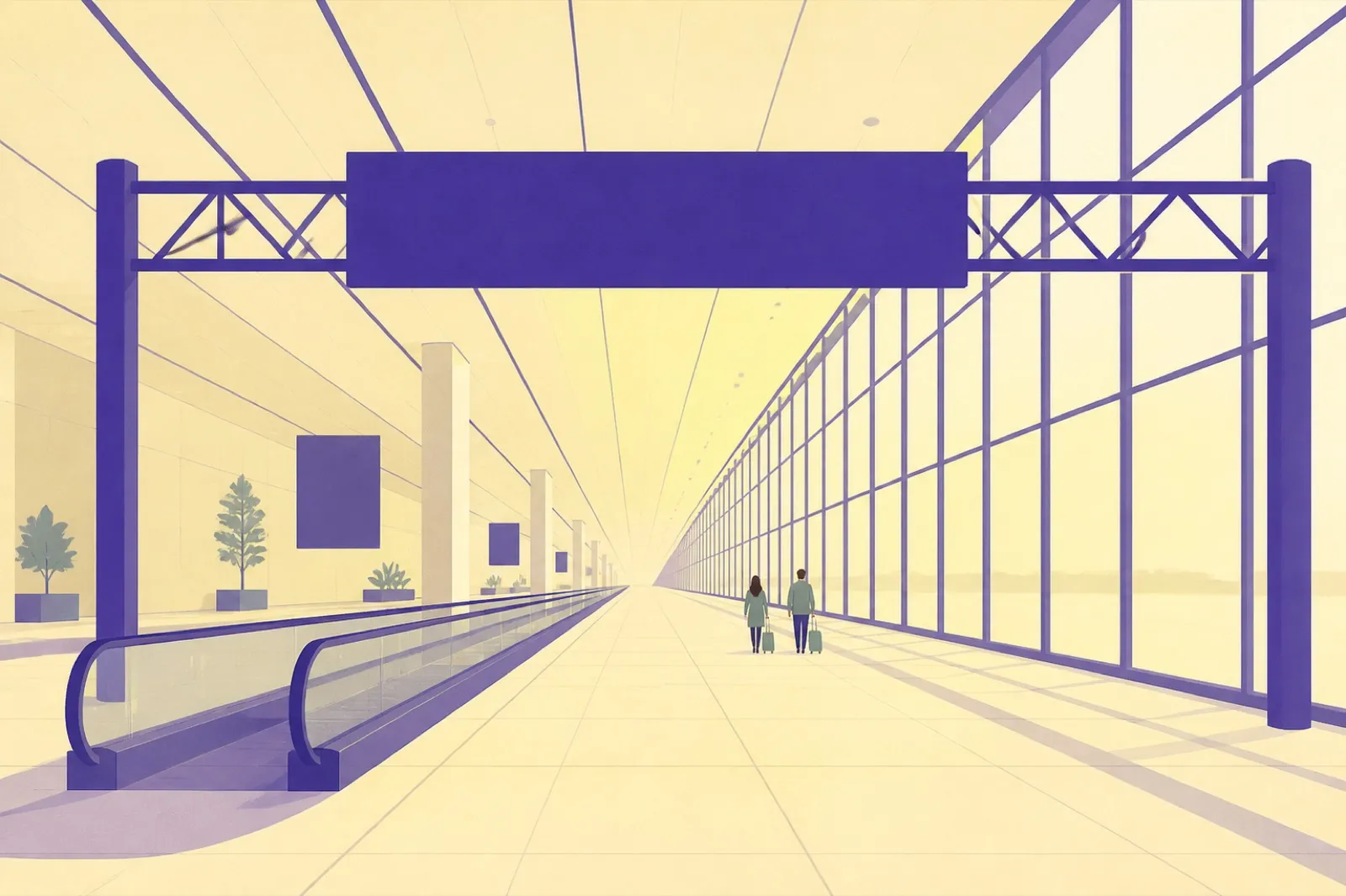
A terminal built for 25 million passengers a year is not a building you cross casually. Piers have to be long enough to park wide-body aircraft along them, which means the gate at the far end is a serious walk from the central hall — at airports of comparable scale, fifteen to twenty minutes is normal, not exceptional.
Everything else on this page follows from that one fact. Long walks are why connection times matter, why boarding times are earlier than travellers expect, and why the phrase “just meet me at arrivals” stops working.
Moving walkways and internal transit are standard in designs at this scale and are part of Long Thanh’s. Whether they are all running in the opening months is a fair question, and one only operation will answer.
The vertical split
International terminals almost universally separate departures and arrivals by level — departures dropping off upstairs, arrivals collecting downstairs — because it keeps two crowds moving in opposite directions from ever meeting. Expect Long Thanh to work this way.
The practical consequence is at the kerb, not inside: a driver who pulls into the wrong level for what you need adds a lap of the airport road system to your day. When arranging a pickup or drop-off, agree the level as well as the door.
Reading the signage on your first pass
Vietnamese international airports sign in Vietnamese and English, with the pictogram set used worldwide. Three habits make a first pass through any large terminal easier:
- Follow the pictogram, not the word. The aircraft-taking-off symbol and the baggage symbol get you further than reading every sign at speed, especially when tired.
- Look up for direction, down for detail. Overhead gantries carry routing; floor-level and desk-level signage carries specifics like desk rows and gate numbers.
- Find the flight information displays early. In a terminal this size the display tells you which of several directions is even relevant. Guessing costs whole minutes here in a way it does not at a small airport.
What to expect in the opening months
Wayfinding is the part of a new airport most often revised after opening, because the designers’ assumptions meet actual crowds for the first time. Temporary signage, taped routes and staff redirecting people are normal in a terminal’s first season and are a sign the operator is paying attention rather than a sign of failure.
For a traveller, the safe assumption is that the building will be less legible in month one than in month twelve — and that the difference matters most when you are tired, carrying things, or short of time.
When the layout is the reason to book help
The terminal’s scale is exactly why arrival assistance and meet-and-greet are worth more here than at a compact airport. An escort does not shorten a corridor. What it removes is every decision inside it: which way at the junction, which belt, which door, which level, where the driver is. On a first visit to a terminal this large, that is most of the mental load of arriving.
For travellers with children or elderly parents, the distances alone often settle the question.